In this blog, we’ll dive into how to calculate payload, GVWR, and towing limits, and how to check if you’re over those limits. Getting this right means a much safer towing experience with less stress when on the road!
Understanding Payload Limits
So, let’s start with the basics of understanding the payload limits of your tow vehicle. Two numbers determine what a half-ton truck (or any tow vehicle for that matter) can safely handle: Payload, or vertical weight, and towing capacity, or horizontal weight.

So, let’s try to understand payload better. Payload is the total vertical weight your truck can carry, including passengers, gear, hitches, tonneau covers, and the tongue weight of your trailer.
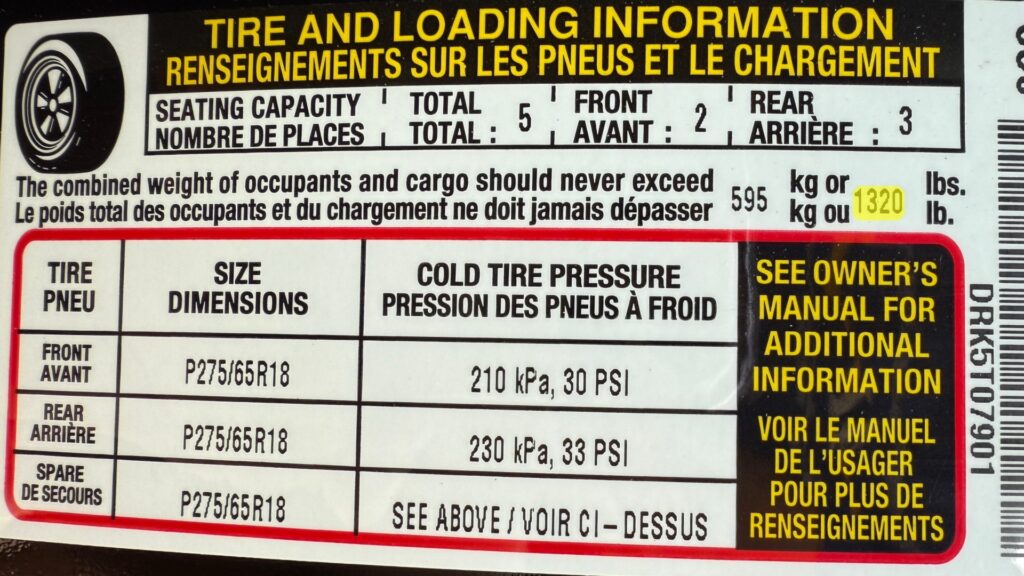
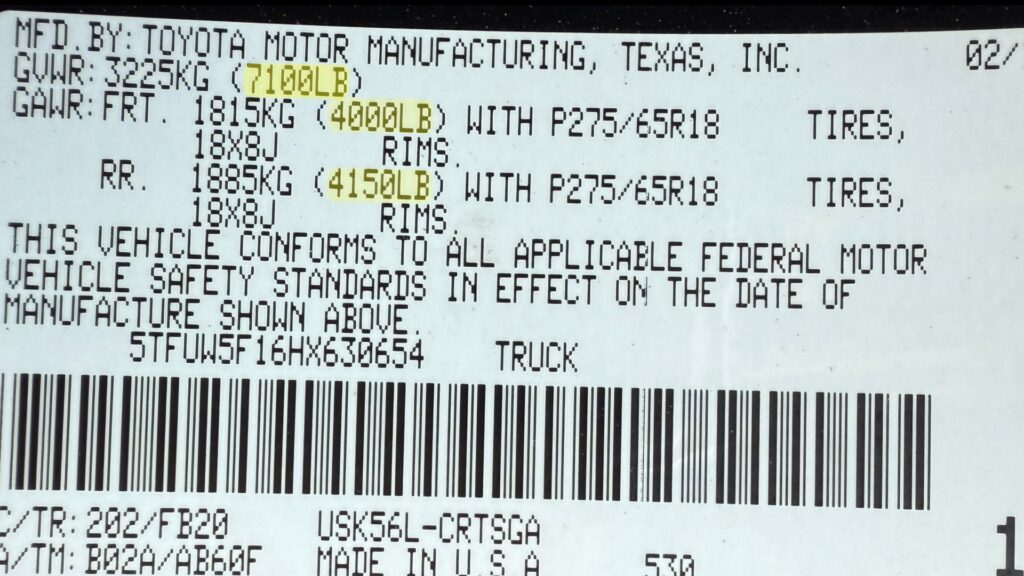
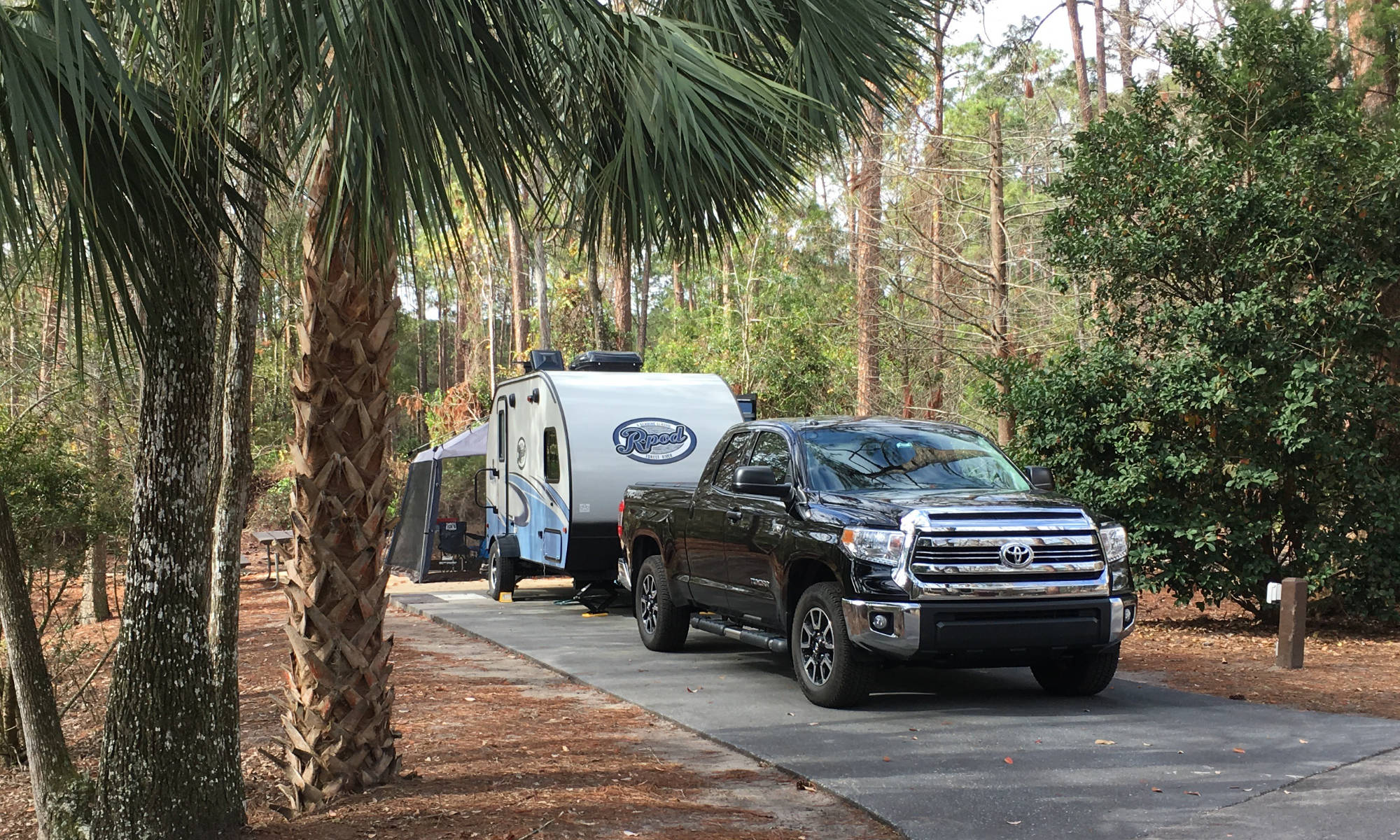
You’ll usually find the payload capacity information on your truck’s driver-side door stickers. My 2017 Toyota Tundra has three door stickers, one with the manufacturing data, which includes the Gross Vehicle Weight Rating or GVWR and axle weight ratings, another sticker that has tire and loading information (including payload), and a third “add on” sticker lowering the payload capacity by 57 pounds due to additional options or equipment added postproduction.
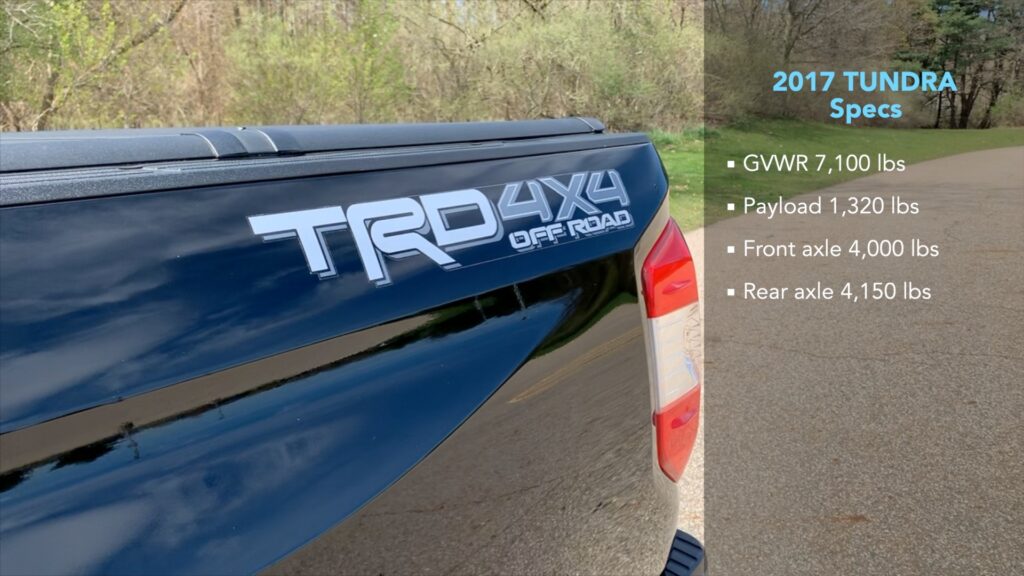
My 2017 Toyota Tundra SR5 Off-Road setup has a GVWR of 7,100 pounds and a factory payload rating of 1,320 pounds. The axles are rated to 4,000 pounds for the front axle and 4,150 pounds for the rear axle.
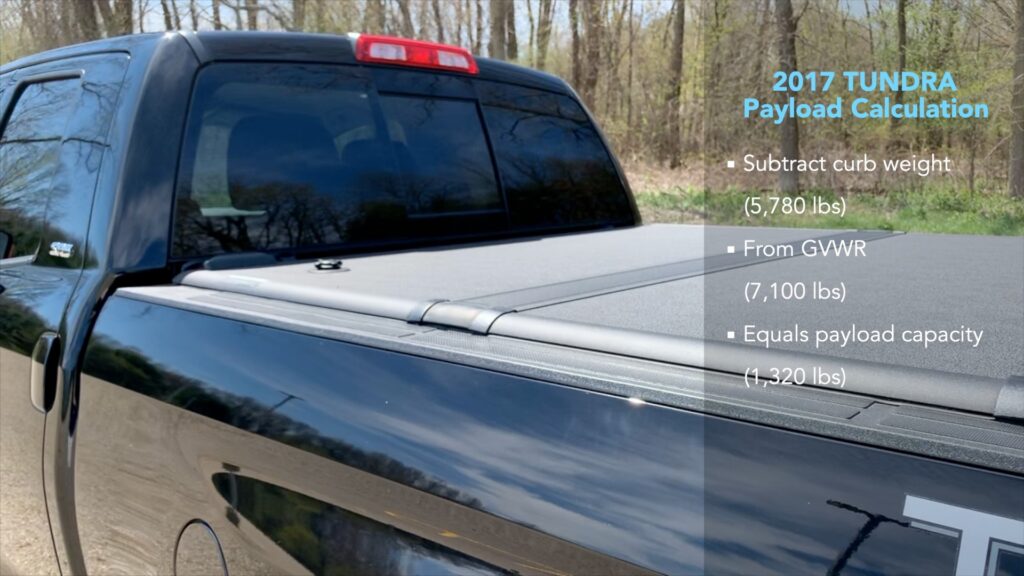
The 1,320 pounds of payload capacity is the subtraction of the curb weight of 5,780 pounds from the GVWR of 7,100 pounds. Be cautious as curb weight is measured when the truck is manufactured. Therefore, any additions or modifications made after purchase (such as my tonneau cover) or options from the dealer, will increase the curb weight and reduce the payload capacity.
Payload Capacity = GVWR – Factory Curb Weight
Considering that payload capacity is a function of GVWR minus curb weight, and that payload capacity is often the main constraining factor for towing with ½-ton trucks, the mysterious GVWR, which the manufacturer sets, tends to be the main limiting factor.
GVWR
So, what is this GVWR, and how does the manufacturer set it?
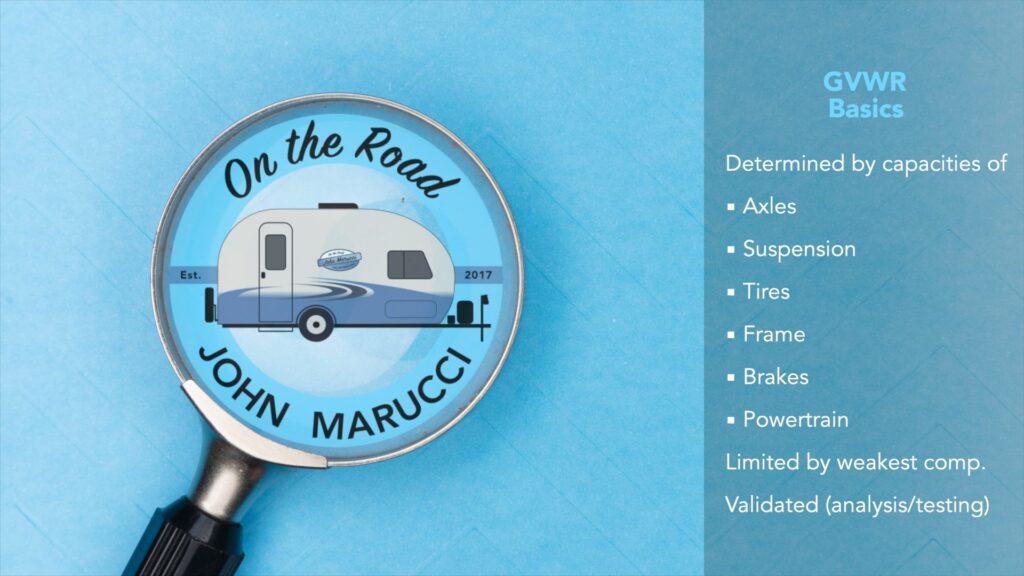
I pulled some basic information on GVWR using the Grok 3 AI tool and this is what was returned, “Truck manufacturers determine GVWR by evaluating the capacity of axles, suspension, tires, frame, brakes, and powertrain, setting the limit based on the weakest component’s safe load capacity, validated through engineering analysis and testing.” However, “manufacturers often build in a safety margin, setting the GVWR slightly below the maximum capacity of components to account for wear, environmental conditions, and driver error.”
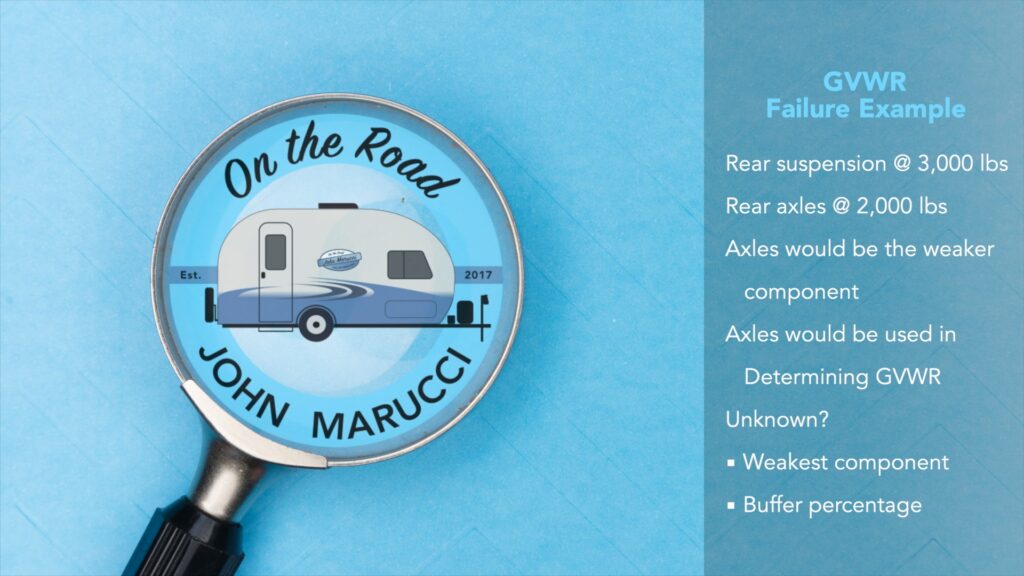
So, the GVWR is a percentage of what the weakest component of the truck can safely carry in terms of vertical weight. For example, if the rear suspension setup on my Tundra failed in motion when 3,000 pounds of vertical weight were applied to the truck in testing, and the rear axles failed at only 2,000 pounds, Toyota would use the axles as the weaker part in determining the GVWR. What is unknown is what part of your truck is the weakest in terms of vertical capacity, and what percentage manufacturers place on the weakest part as a buffer.
Effective Weight
Another consideration in calculating GVWR is that the manufacturer’s testing is likely not static. Two thousand pounds of vertical weight is much more when you hit an 8-10” pothole on an interstate. This is known as dynamic loading and impact force, which means the effective weight can be much more than the static weight.
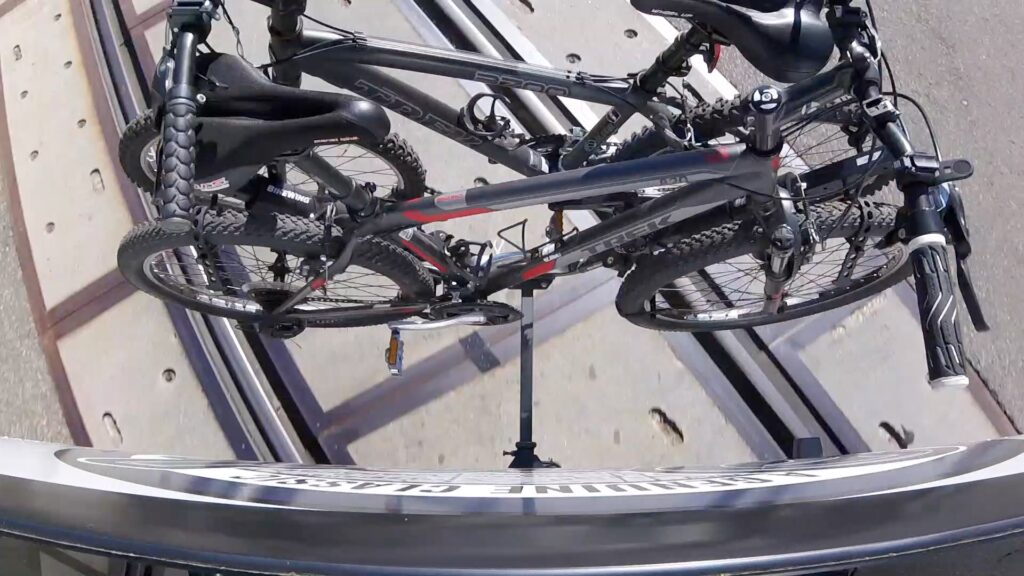
This effect can be seen when bikes are put on the back of an RV and bounce around. The effective weight of the bikes is significantly more than their static weight when they are bouncing over road construction, potholes, or railroad tracks. This is why most failures to bike hitches occur on rough patches of road. This is all to say that any buffer in GVWR a manufacturer adds may be more than just a legal move to cover liability. The actual stated GVWR is likely barely sufficient, given the realities of dynamic loading, impact force, and effective weight.
Braking
Another issue is braking. I once heard Kristy Michael of Long Long Honeymoon say something like this about towing: I am much more concerned about how much weight my truck can stop versus how much weight it can pull. As you may have noticed, brakes were part of the manufacturer’s testing that determines the GVWR. Ensuring your truck can stop effectively is no minor safety issue, particularly given the payload it carries. This is why insurance companies often will not cover you in an accident while towing if you are over your weight limits. Your truck’s brakes are made to operate properly up to the manufacturer’s GVWR and not beyond this, so be aware that if you take liberties with payload, you may be uninsured for the incident if an accident happens.
GVWR is essentially a black box with little transparency from the consumer’s perspective, which I would argue leads many people to ignore it. The manufacturer is likely conservative with its vertical weight limits, except in the most rigorous testing, which covers the effective weight of cargo.
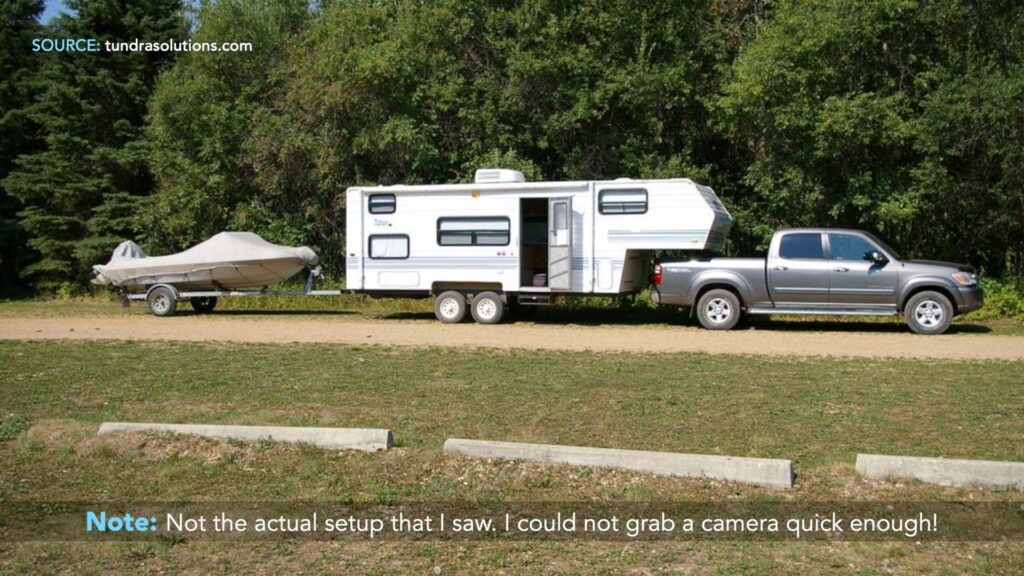
I have seen a Toyota Tundra towing a fifth wheel with a boat attached to the back of the fifth wheel! The truck didn’t implode on the highway, yet they had to be hundreds of pounds over GVWR by doing so. The long-term consequences of abusing the truck in this manner are problematic, and the wear of weaker components will likely trigger issues as the truck ages.
Given the realities of dynamic loading and impact force on your truck, as well as braking issues associated with overloading the payload, I think it is prudent not to ignore the very real payload limits of your tow vehicle. What buffer the manufacturer states based on the weakest part is likely counterbalanced by the strain on braking capability and impact force of critical parts. Add the potential insurance issues if you are found to be overweight in an accident, and it just doesn’t make sense to risk it on payload.
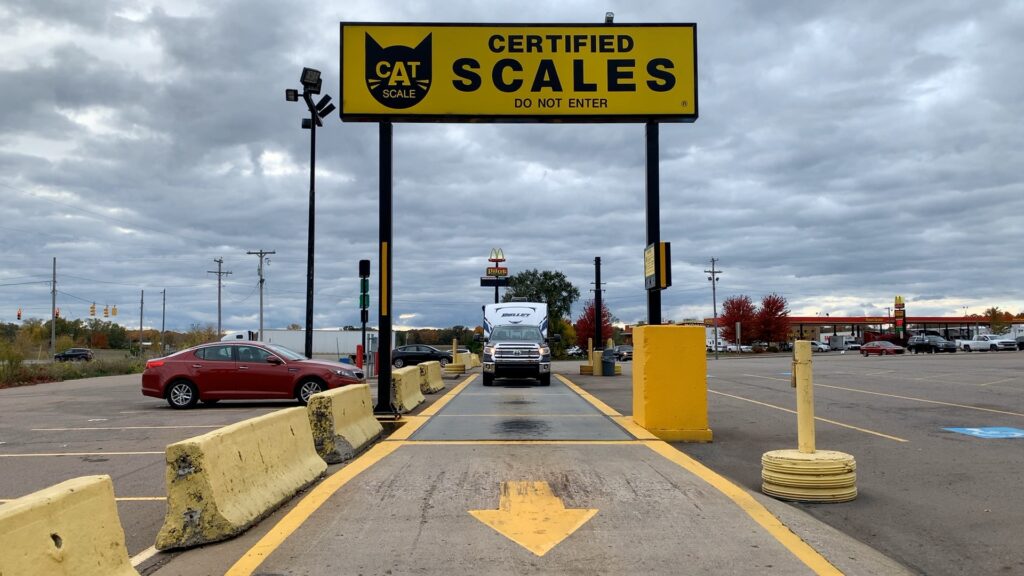
One final point. The best way to tell where you are in terms of payload capacity is to use a local CAT Scale at a truck stop with your truck loaded for a camping trip (including passengers). You will also need to have your trailer ready for camping so that you can get an accurate measurement at the CAT Scale. There is more to using a CAT Scale, and we cover some of it in a video on using a weight distribution hitch. We may go into more detail at a later point.
That should do it. All the best in your camping adventures!
As always, thanks to our fans who support our efforts by starting their shopping from our Amazon Storefront and their generous financial support by using the THANKS feature located under each YouTube video ($ within the Heart icon). Your support is greatly appreciated!