
This blog will cover the latest RV and travel data news. May 2026 RV production numbers are out, and we’ll cover the latest travel data so you can better gauge if it’s time to buy, sell, or hold an RV. Later in the news, we’ll look at why the RV industry is in peril.
RVIA Numbers
On June 25th, 2026, the RVIA posted the latest RV wholesale shipment data for May 2025. Production was again down significantly compared to the prior year, with 22,900 total RVs shipped in May, down by 5,250 units year-over-year. May 2026 was the lowest production month since before 2016. Looking at the May only bar charts, we can see that May 2026 is the lowest over the past 10 years. Compared to Year-to-Date 2025 volume of 161,373, 2026 through May is down by 23,213 units to 138,160, or down by 14.4%. 2026 TYD was only 2,575 more units than 2020 YTD, during the pandemic.
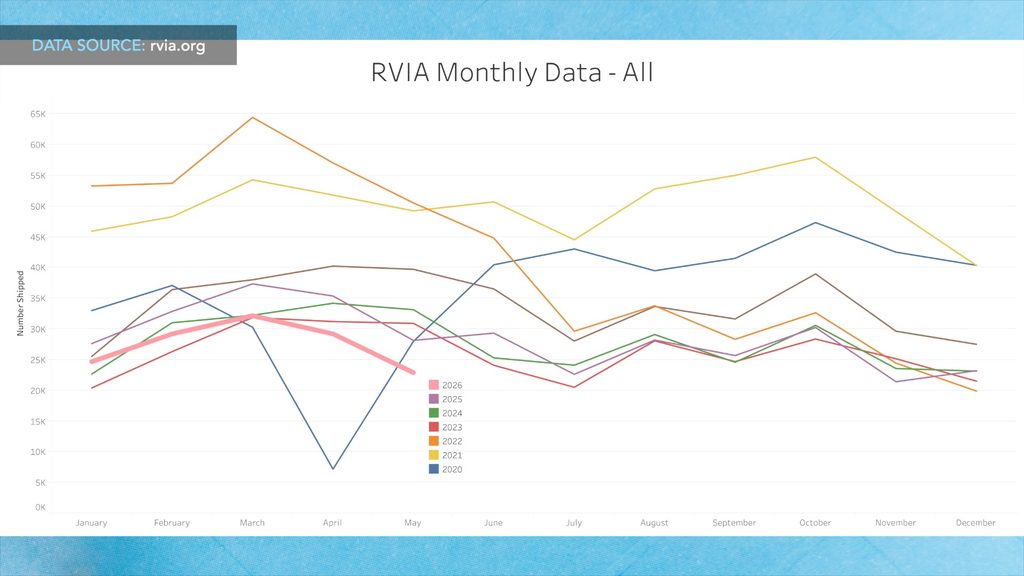
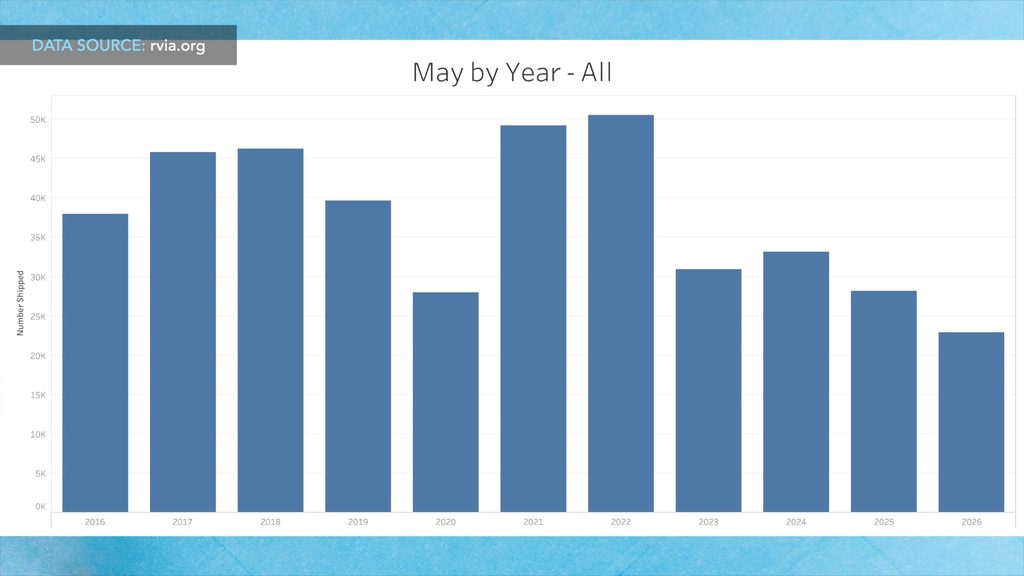
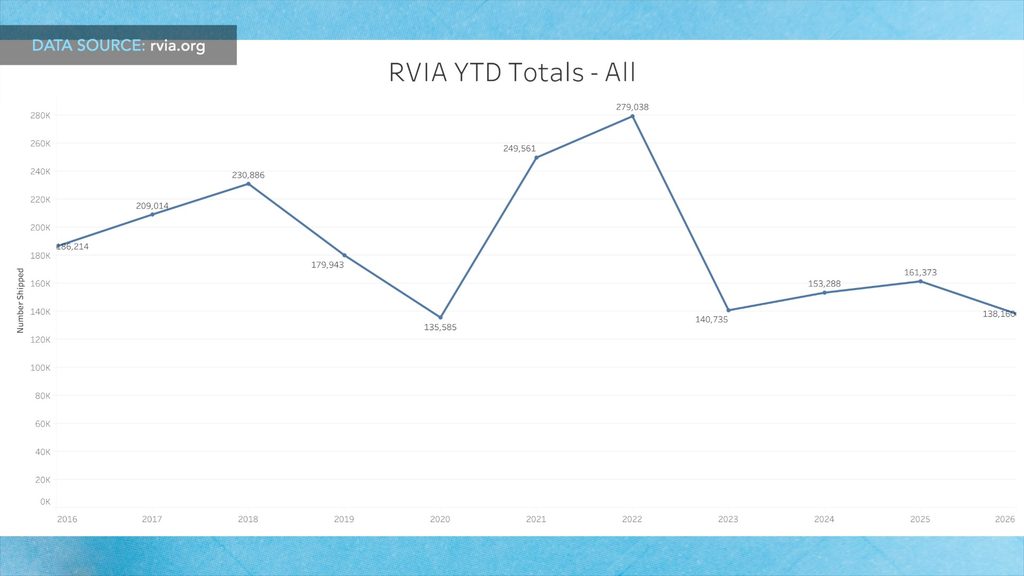
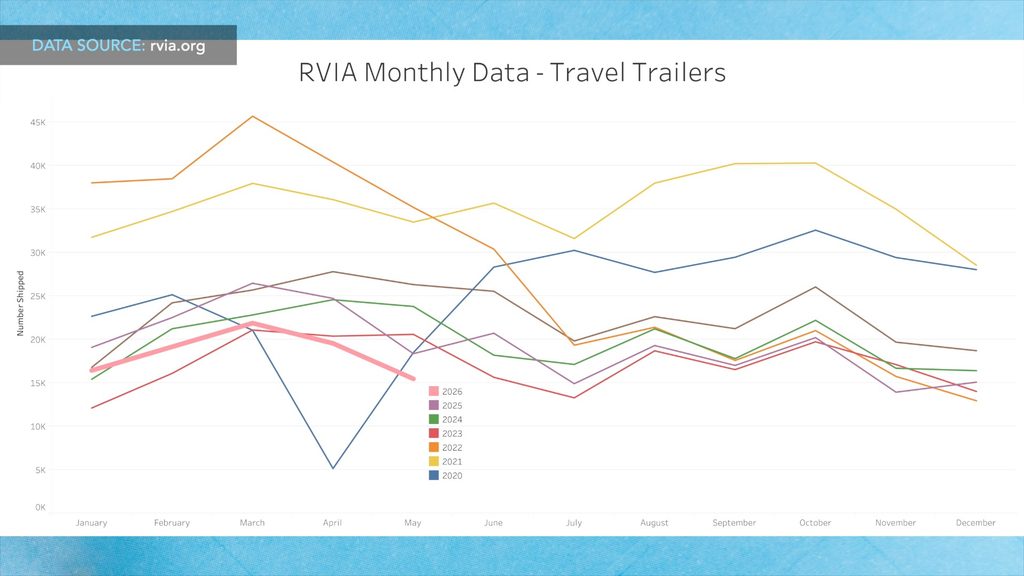
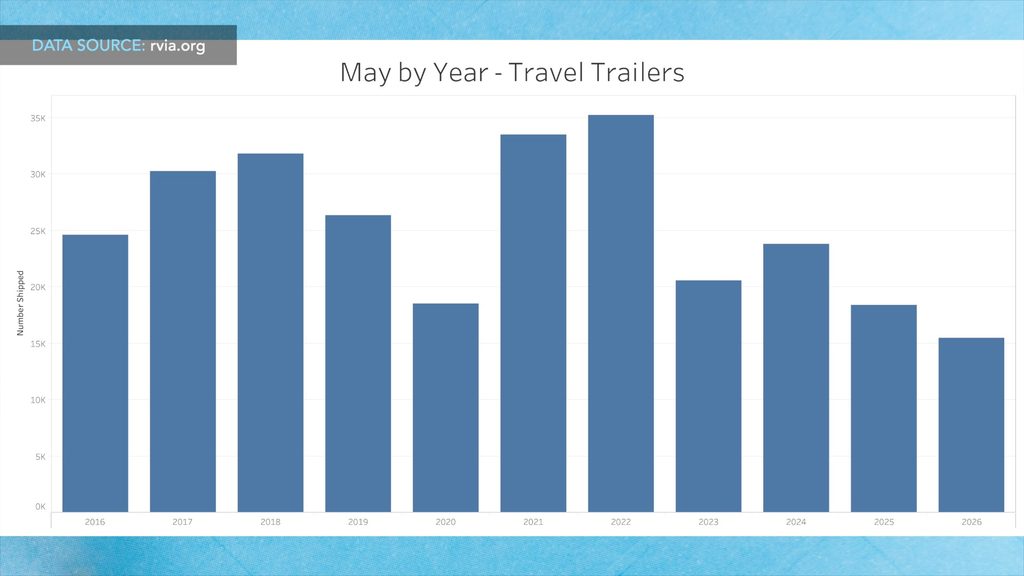
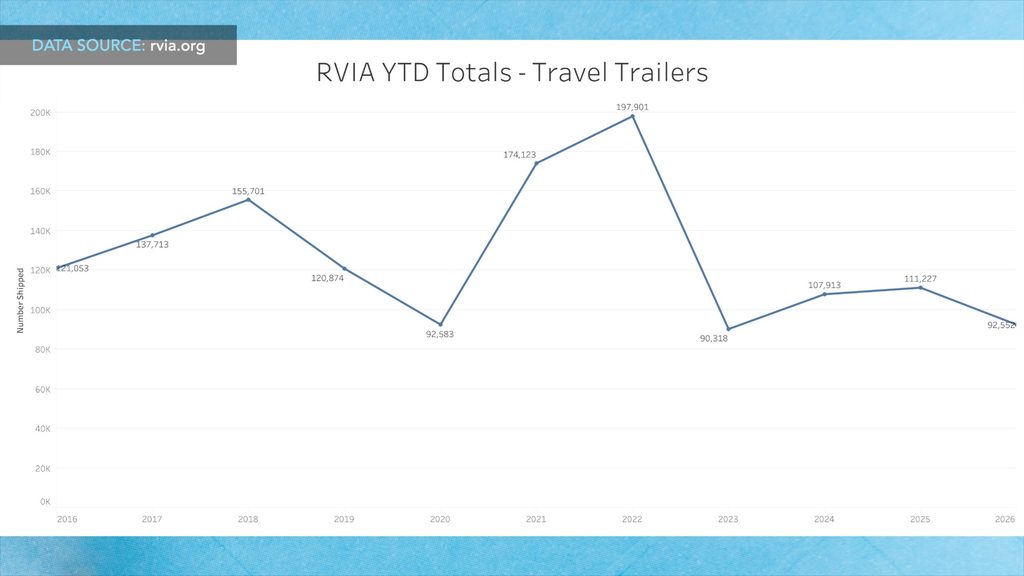
Travel trailer shipments decreased year-over-year, with 15,480 units shipped in May 2026, compared to 18,376 a year ago, representing a decrease of 2,896 units, or -15.8%. Travel trailers had their lowest May on record since before 2016. Looking at the May only bar charts, we can see that May 2026 is the lowest over the past 10 years. Compared to Year-to-Date 2025 volume of 111,227, 2026 through May was down by 18,675 units to 92,552, or down by 16.8%. Besides 2023, 2026 is the lowest YTD production run for travel trailers since before 2016.
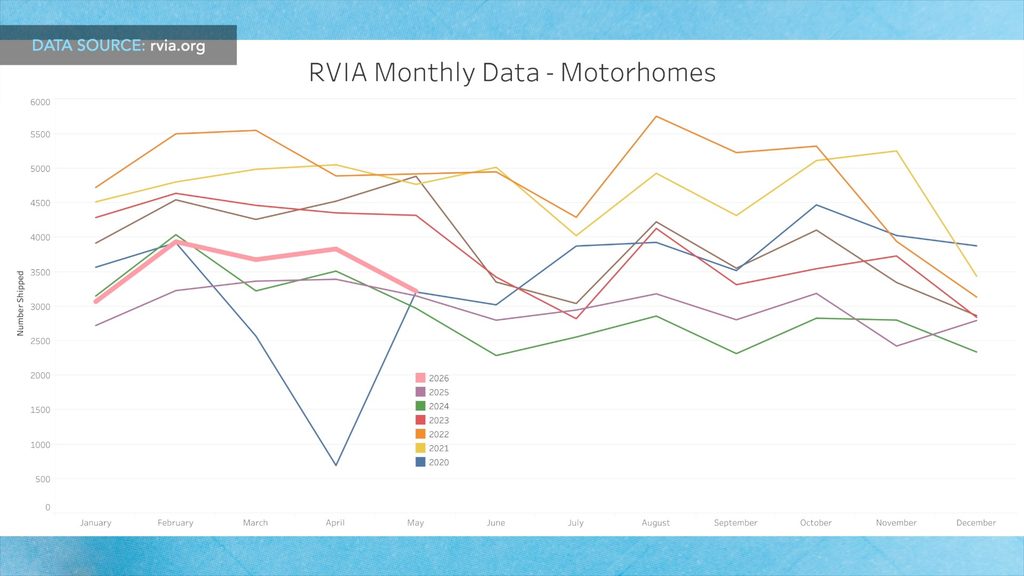
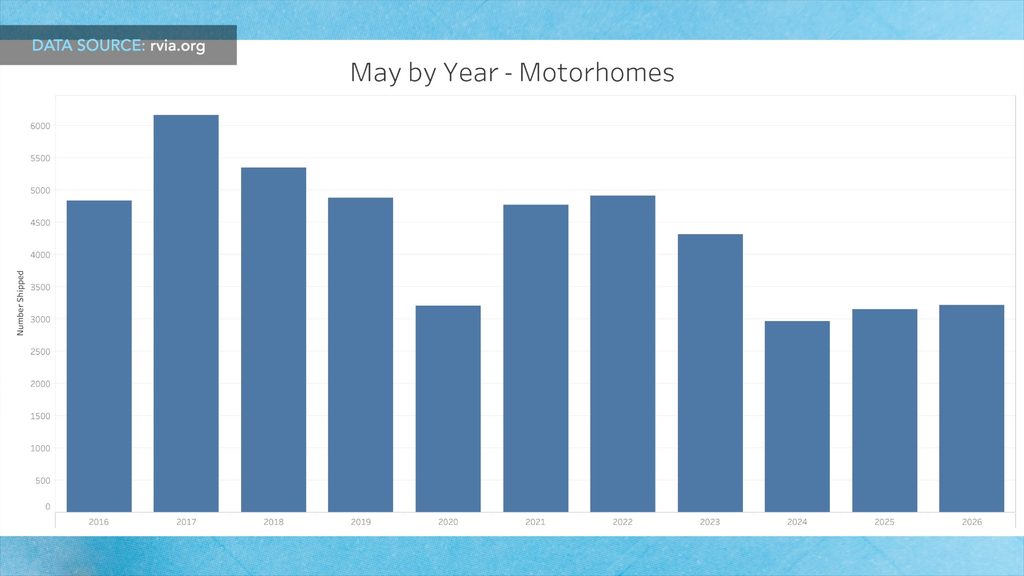
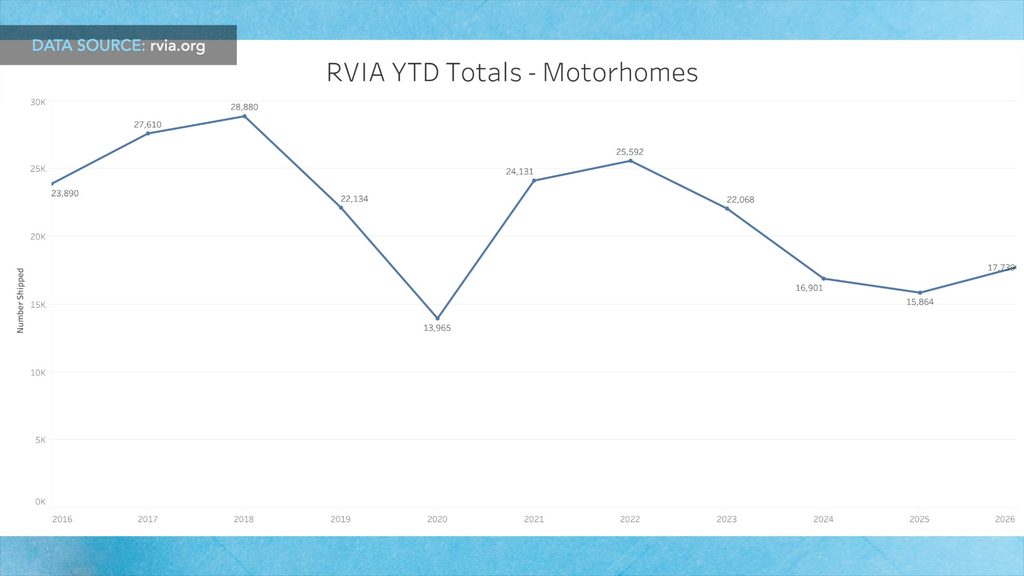
Motorhome shipments, which include Class A, B, and C motorhomes, were higher than in May 2025, with 3,221 units shipped versus 3,153 a year ago, an increase of 68 units or 2.1% year-over-year. Motorhomes were up in May verses recent prior years. This gain is almost wholly driven by Class B camper vans, as Class A motorhomes continue to see a sharp decline. Compared to Year-to-Date 2025 volume of 15,864, 2026 through May was up by 1,875 units to 17,739, or up by 11.8%.
RV Trader Numbers
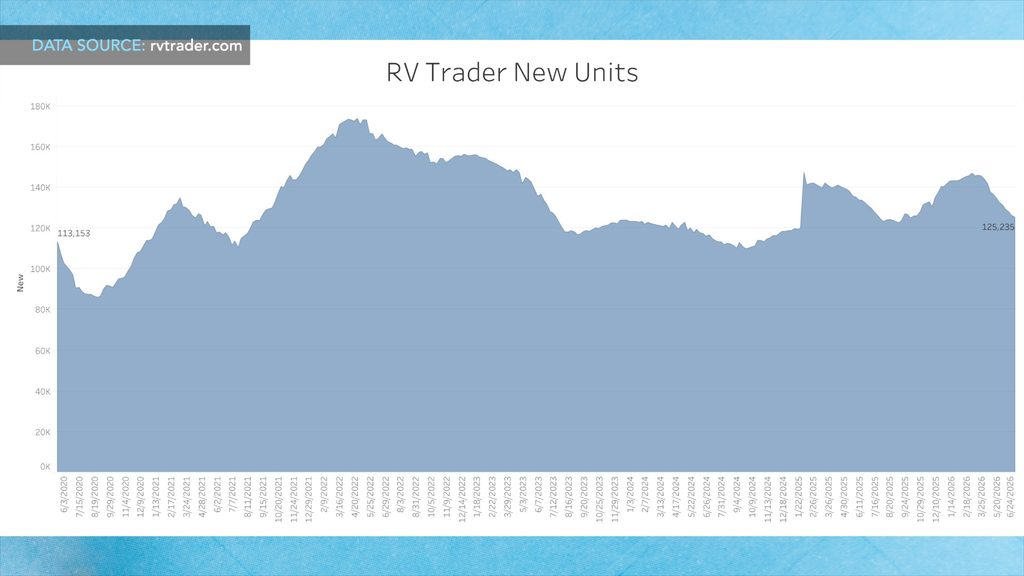
RVs for sale on RVTrader.com have decreased sharply since last month, with 125,235 new RVs listed as of July 1st, 2026. This is down sharply from 131,348, or 6,149 units, or 4.7% from a month ago, and down 5,852, or 4.5% from a year ago. It seems that dealers are advertising fewer new RVs for sale this year, as the switch to selling cheaper used RVs seems to be occurring among many dealers.
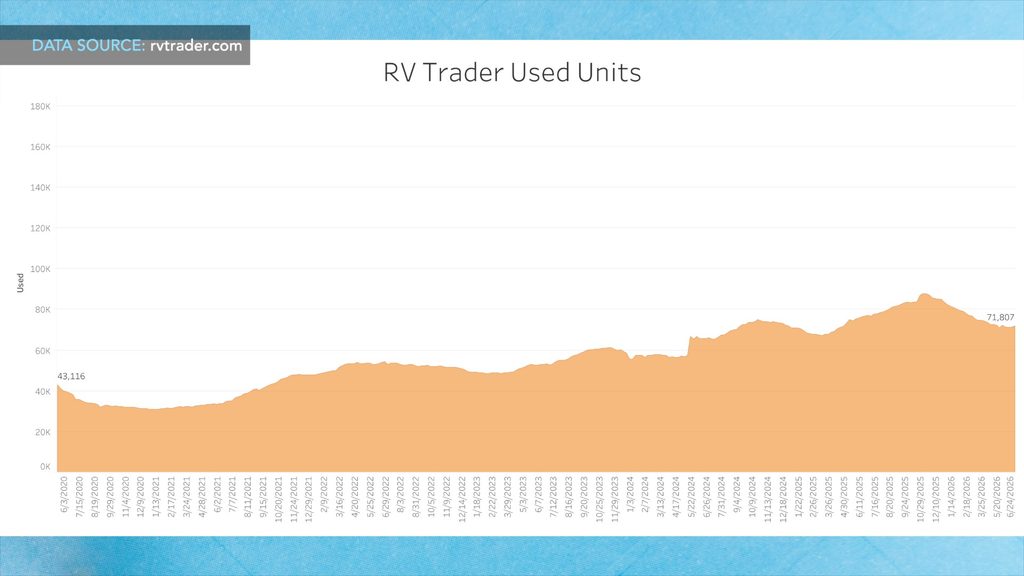
The number of used units for sale has decreased slightly since last month, with 71,807 used RVs for sale as of July 1st. This is down by 333 units, or 0.5%, compared to about a month ago but down sharply by 5,148 units, or 6.7%, compared to a year ago.
Model Year Charts
Our model year chart, based on weeks on market, shows that 2026 models are falling off quickly and are now below 2025s vs. the prior year at the same point in time. At the same 70 weeks on market there are many fewer 2026 models vs. 2025s, yet many more than 2024s at the same time on market. It seems like 2026s are running off at a quicker rate versus prior years and may indicate earlier seasonal dealer discounting.
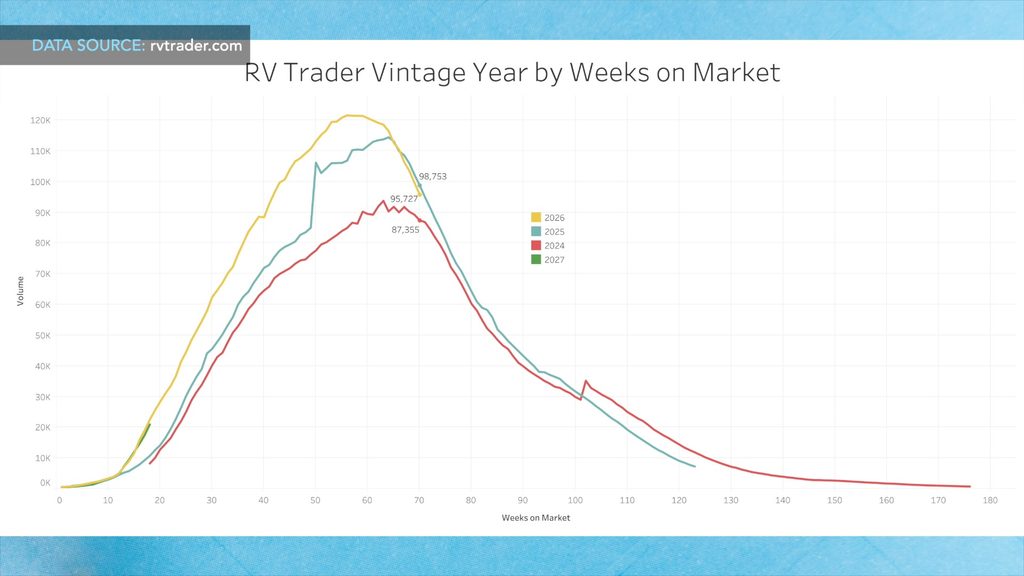
As a reminder, many but not all dealers advertise on RVTrader.com to sell inventory. It remains an excellent proxy for overall dealer inventory. You can follow my account on X at @JohnMarucci to receive weekly updates on this data.
BLS RV Manufacturing Labor Stats
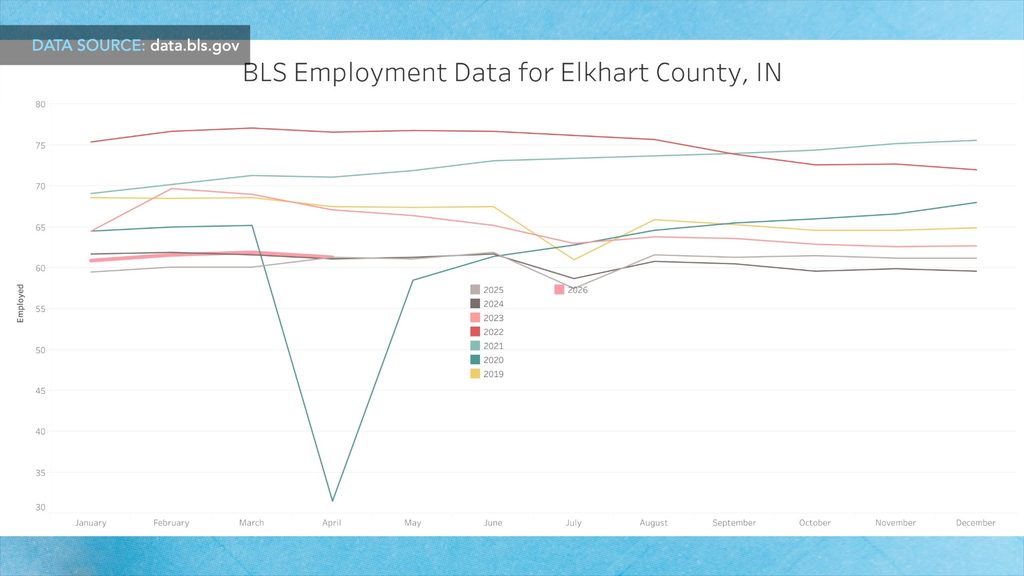
The Bureau of Labor Statistics published revised April 2026 manufacturing employment numbers for Elkhart County, Indiana. This is an indicator of RV manufacturing growth or decline. April 2026 manufacturing employment level declined to 61,300, tying April 2025, and just above 2024 employment levels. The BLS is forecasting that manufacturing employment will hold steady for May 2026.
AAA
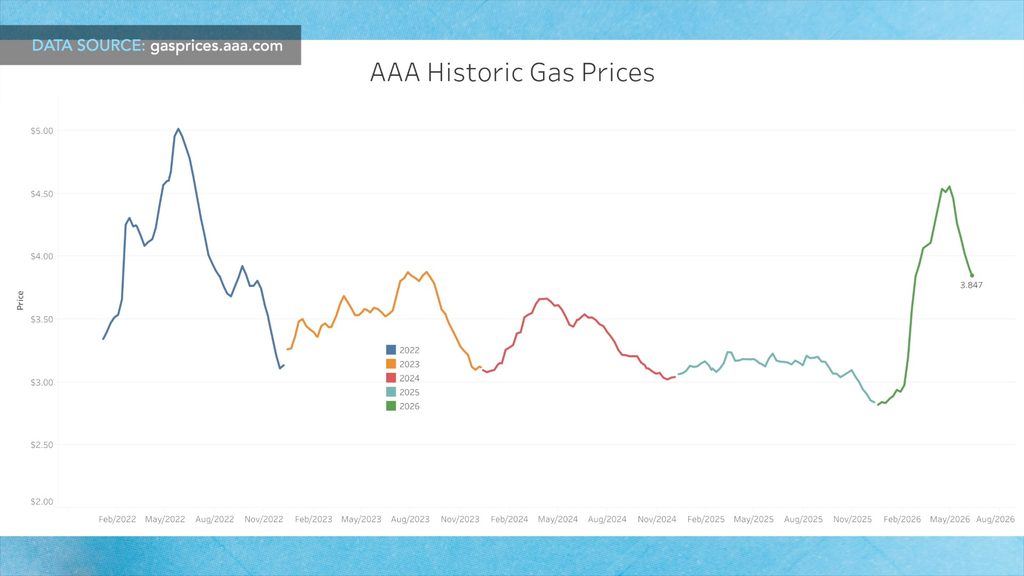
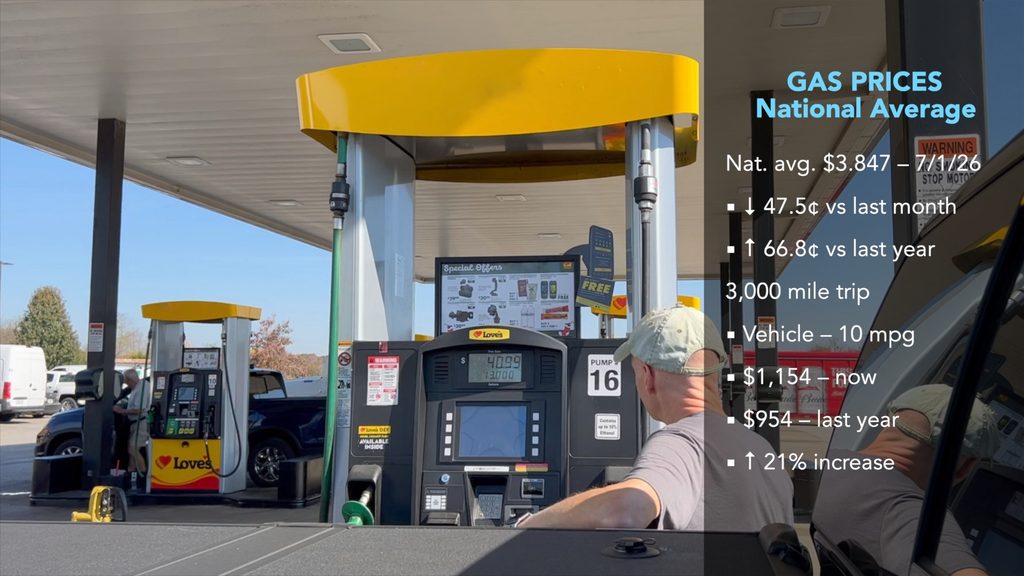
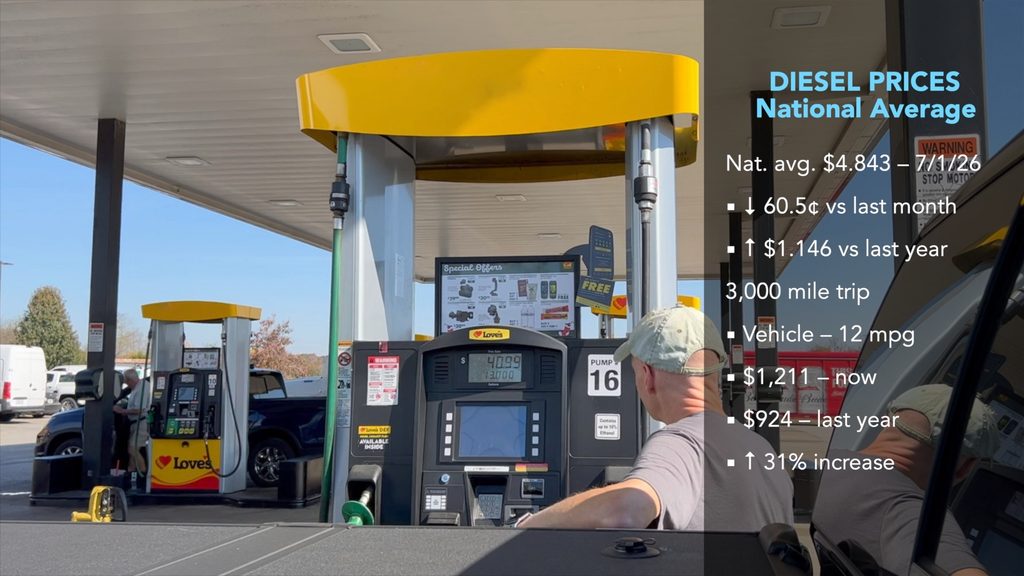
Gas prices have declined in the past month after hitting multi-year highs this Spring. According to AAA, the current average nationwide price as of July 1st was $3.847 per gallon for regular unleaded, down 47.5 cents from a month ago and up 66.8 cents from a year ago. An RV trip of 3,000 miles at 10 mpg would cost $1,154 now vs. $954 a year ago, a 21% increase. Diesel prices have decreased over the past month and currently stand at $4.843 per gallon, down 60.5 cents versus a month ago and up $1.146 from a year ago. A similar 3,000-mile trip, getting 12 mpg, would cost $1,211 now, compared to $924 a year ago, representing a 31% increase.
Is the RV Industry in Peril?
Recently sales reports have shown that new RVs are not selling well, and used RVs may be the go-to for dealers to move inventory. You can gather this somewhat from the data I just presented as May 2026 was the worst May for RV production deliveries since before 2016, including the pandemic year of 2020. I think there are three main factors influencing the current lack of sales: quality, inflation, and weight.
Pandemic Quality: The Mass Inoculation Event
First, let’s talk about RV quality. The quality of any hand-made item depends upon the experience of the worker and the time spent on the unit. This is why for high-end products, like Martin guitars, for example, you have very high skilled long-term workers who are plying their experience at a reasonable pace. The results are incredible guitars. Variation (differences in build process) is the enemy of quality for hand-made items, and variation is mainly a function of inexperience and speed of the process. You need skill and a reasonable build pace to generate less variation.

During the pandemic, the perfect storm of high demand facilitated massive hiring which equated to faster production by less experienced line workers. Thus, we have forever etched, the 2021 and 2022 “pandemic trailers.” The poor quality equated to long-term inoculation of hundreds of thousands of new RVers because of massive variation for these hand-made units. Social media magnified the post-sale quality issues, but in my opinion, online criticisms weren’t unwarranted.
Summary: You can’t build hand-made items fast and by inexperienced workers or you lose your reputation, maybe forever.
It Costs What?
Next, let’s talk about pricing and inflation. Inflation occurs when too much money chases too few goods. Why are RVs so expensive now verses pre-pandemic? Pandemic demand certainly helped change pricing, and government injection of funds into the economy also factored in. Remember the series of $1,200 government direct payments during and after the pandemic? The money multiplier enabled increasing demand and then shortages. Parts shortages increased the wait times for RVs and added to the input prices for building RVs. At some point with prices increasing rapidly, the consumer’s reference point (what they think something should cost) got out of whack with new pricing. In essence, higher inflation rates fast-forward pricing perceptions, sometimes by many years. This is why things seem too expensive now, and RVs are a good example of this. Couple this higher pricing with quality issues and the all-important value exchange changes.
Summary: People won’t buy something they don’t think is a good value exchange. With inflationary pricing, new RVs with a perception of poor quality now generally fall into that category.
Weight Gain
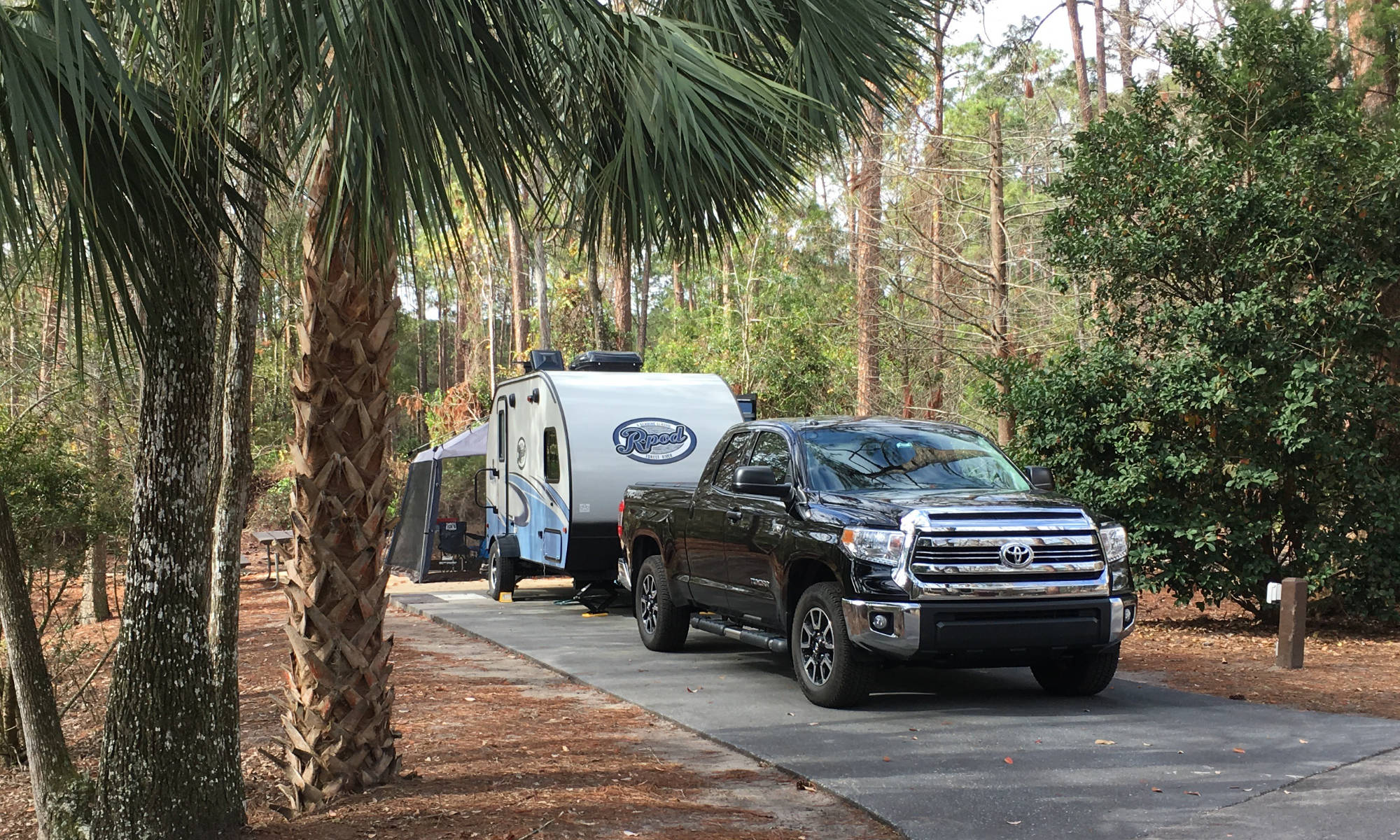
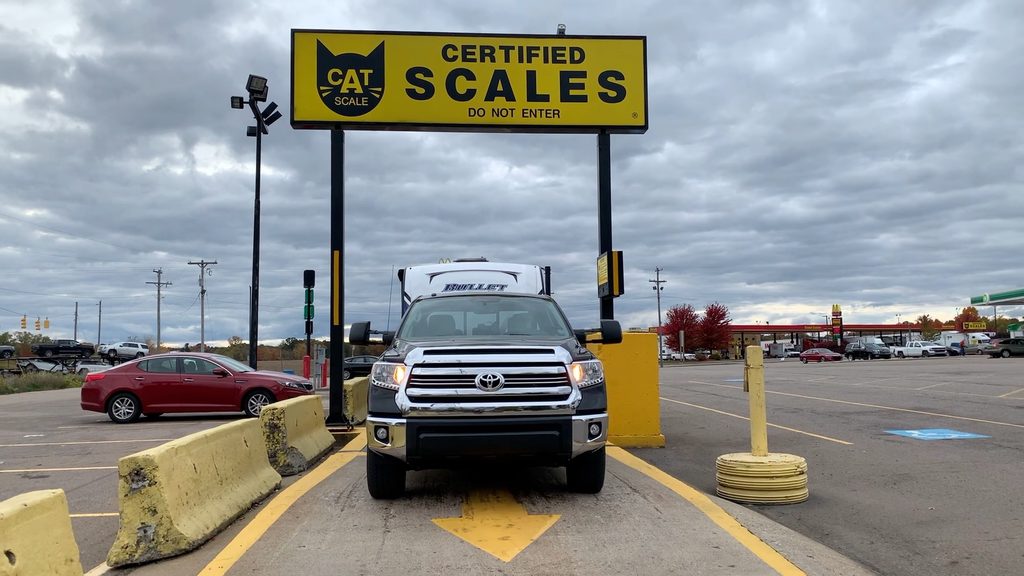
Finally, let’s consider weight gain for travel trailers. Newer trailers seem to have become heavier. I have occasionally shopped for a new travel trailer during the past few years, and I always seem to trip up on the tongue weight of newer RVs. My 2017 Toyota Tundra has been a stellar ½ ton truck, and it can squeeze through a Chick-fil-a drive through, but it isn’t great on payload. It handles my 2020 Keystone Bullet well even with curtailed payload on the truck, but it won’t manage the tongue weight of many newer travel trailers.
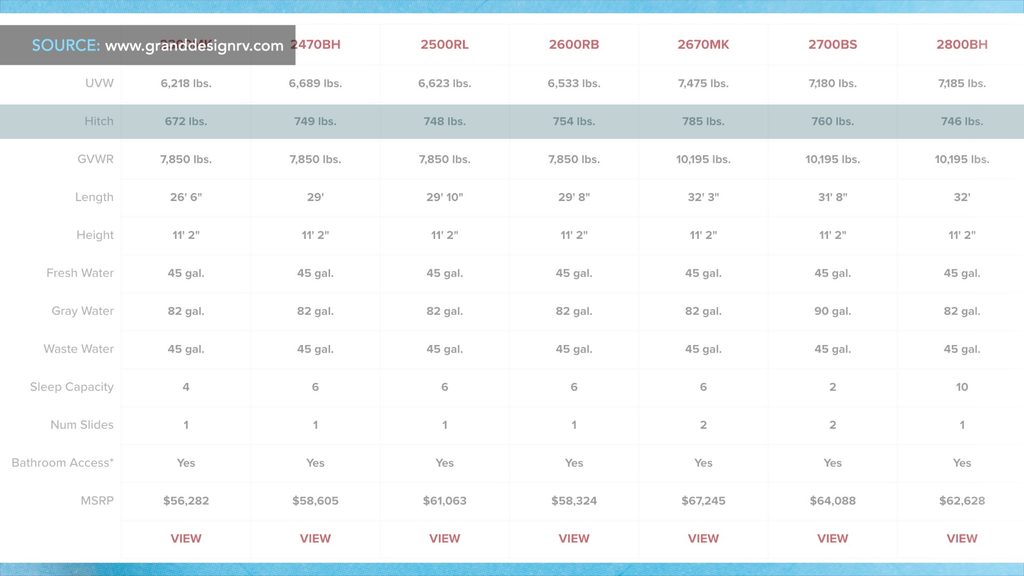
Here are the seven lightest Grand Design travel trailers. Notice the lightest tongue weight of them all is 672 lbs. with the trailer unloaded. My Keystone is 2ft longer and nearly 100lbs. lighter in tongue weight, and I am right at the border for payload of my Tundra. So, none of these Grand Design travel trailers would work without a truck upgrade, which I have no plans to do. That new trailer gets much more expensive when you have to upgrade trucks as part of the purchase.
Summary: Many people don’t want to have to buy a new tow vehicle to buy a new travel trailer. Weight matters.
Conclusion
Overall, the ongoing perception of poor build quality, the roots of which took hold over the past several years, coupled with much higher pricing, has all but destroyed the value exchange for many potential customers. Also, building heavier units blocks out many potential customers like me who have no plans to buy a new truck to go RVing. It has certainly put RV manufacturers in a precarious place.
That should do it. All the best in your camping adventures!
As always, thanks to our fans who support our efforts by starting their shopping from our Amazon Storefront and their generous financial support by using the THANKS feature located under each YouTube video ($ within the Heart icon). Your support is greatly appreciated!